
Company · Newsroom · 18 November 2026
Governed AI for regulated firms: RegAI launches in Amman
At Fairmont Amman, AIGC and Cogniveil launched RegAI and showed risk, compliance, and audit leaders what governed AI for regulated firms looks like.
AIGC and Cogniveil launched RegAI in Amman, with risk, compliance, and audit leaders asking what governed AI for regulated firms looks like.
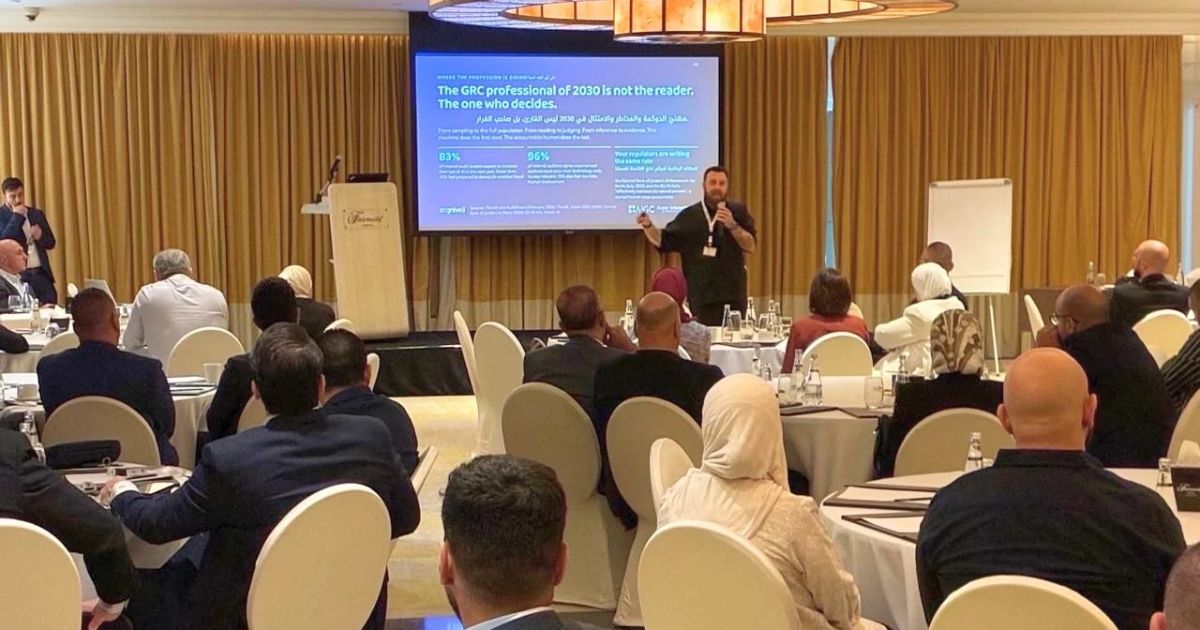
On 19 October 2026, Aldar International for Governance Consultancy (AIGC), our MENA partner, hosted The Next Evolution of CAREweb: Governed AI for Regulated Firms at Fairmont Amman. CAREweb is AIGC’s governance, risk, and compliance (GRC) system, and the event set out its next step: governed AI, with Cogniveil as AIGC’s technology partner. The room held risk, compliance, and audit leaders from across the region. The day moved from a keynote to a live demo and an afternoon workshop, where attendees brought their own AI problems and our team worked through them with the room.

The question in the room was how to bring AI into a regulated institution and keep control of its data and its decisions, and most conversations started with the data. Together with AIGC, we launched RegAI at the event as part of the answer. RegAI by AIGC, powered by Cogniveil, brings AIGC’s GRC methodology together with Cogniveil’s governed AI. It reads a new regulation article by article, proposes the risks and controls for each article, and leaves the decision with your compliance team.
What was the room asking?
The room was asking how to use AI under its own control, and the biggest question was whether the data leaves the building. Dimitris Dimitriadis, Founder & CIO of Cogniveil, gave the keynote and started from what everyone there knew: two in three people use AI, and fewer than half trust it.
During the keynote, he named the risk already inside most institutions: shadow AI, staff using AI tools their institution did not provide. A ban leaves that use where it is, and what moves it is “a governed alternative inside the systems your people already work in, so the sanctioned path is also the easier one.”
Why did most conversations turn to data?
Most conversations in Amman turned to data because the rules on data come first: where the data lives, whether it may go to a cloud, and what the regulator allows. In Jordan, banks answer to the Central Bank of Jordan, which sets the expectations a bank must meet for the technology it deploys, including how customer data is protected. The question of where AI runs therefore comes before the question of what it does. Data is also the risk behind shadow AI: a public AI tool sends the institution’s text to a service it does not control.
We start from the same place. Each institution chooses where Cogniveil runs, on premises or air-gapped when it must be and hybrid when it should be, to match the supervisory expectations it answers to. The rules decide where the data stays, and the platform works within them.
What does governed AI for regulated firms look like in practice?
In practice, it means one new regulation taken from the text to the register under a named person’s signature. Together with AIGC, we showed this with RegAI, which split the regulation article by article and proposed the risks and controls each article creates, each cited to the legal text. Where an article creates no duty, it proposes none. A named person approved or edited each proposal, and nothing reached the register until that person signed. For institutions that run CAREweb, the approved risks and controls flow straight into it, and RegAI also works on its own for institutions that do not. In our tests on articles held back from training, its proposals reached 99% agreement with the risks and controls that professionals had signed.
We also showed what happens when a revised edition arrives. RegAI lines up the old and the new text article by article, marks the exact words that changed, and explains only those, so your team starts from the material changes. In our tests across three pairs of regulations, 97.3% of the material changes it published were right. In the demo, new regulations, amendments, and circulars from the regulators an institution follows came into one place, each linked to its source on the regulator’s site.
The platform’s interface is available in Arabic, with a full right-to-left layout, so the people doing the regulated work read it in the language they work in. Across our compliance work, the same boundary holds: deciding what a change means for the business remains the compliance officer’s call.

Which principle sits behind RegAI?
The principle is the one Dimitris put to the room:
“The machine does the first read. The accountable human does the last.” Dimitris Dimitriadis, Founder & CIO, Cogniveil
We built the Cogniveil platform on that principle, and RegAI runs on that platform. AI coworkers do the work: named roles with a job description, approved sources, guardrails, and a human supervisor, with every answer connected to its source and every decision kept with your people.
Four questions to take back to your institution
The day left four questions worth asking before AI goes into a regulated function. Each one can be answered inside your institution before any tool is chosen.
Where may your data go? Check what your regulator allows on cloud use and cross-border transfers before you choose where AI runs.
Where is AI already in use? Ask which public tools people use for work today, because that use exists whether or not a policy allows it.
Who signs before anything reaches the register? Name the person who approves each AI output before it becomes part of your register or your records.
Can every answer show its source? Check that a reviewer can open the source behind each answer, so review means checking the work.
How do you start?
Bringing AI into a regulated institution starts with one workflow, run where your rules allow, with its output signed by the people accountable for it. For a first workflow, bring one new regulation, the register it feeds, and the person who signs for it to a demo or see how Cogniveil works in Jordan.
Cogniveil is a governed AI platform for regulated industries, built for audit, compliance, risk, finance, legal, procurement and onboarding teams. cogniveil.ai
Continue